
Winter condensation happens when warm, moist air inside a sealed building meets a cold surface. Spring condensation happens for a different reason: a building’s surfaces, roof, structural steel, stored product, ductwork, are still cool from overnight temperatures while daytime air warms and picks up moisture quickly, so the mismatch between the two, not the cold itself, is what causes moisture to form. This article answers a different question to our winter condensation guide. Not how to stop moisture building up in a sealed space, but why it’s showing up now that the weather is warming.
The mechanism: why spring condensation is a temperature-lag problem
Building mass, roof sheeting, structural steel, stored product, ductwork, has thermal lag. It cools overnight and takes time to warm up again during the day. When daytime air, now carrying more moisture as spring humidity rises, contacts a surface that is still below the air’s dew point, condensation forms on that surface even though the building isn’t sealed or cold in the way a winter scenario is.

This is a day and night differential problem, not an insulation or sealing problem, which is why winter fixes such as reducing moisture generation or sealing gaps don’t fully address it. The surface causing the problem isn’t cold because the building is poorly insulated. It’s cold because it hasn’t caught up with the air around it yet.
Why this spring’s conditions raise the risk
The Bureau of Meteorology’s climate outlook issued 17 September 2026 shows an increased chance of above-average rainfall across the west and central regions, and notes that widespread warmer-than-average sea surface temperatures around Australia can enhance atmospheric moisture and energy that fuels storms and higher-intensity rain. The same outlook shows daytime and overnight temperatures likely above average across most of the country.
Combined with the temperature swings inherent to spring, this means the ingredients for surface condensation, more atmospheric moisture and a wider day-to-night temperature gap, are more present than in an average spring. This is a probability from BOM’s forecast, not a certainty, but it’s a reasonable prompt to check exposure before the ingredients line up rather than after.
Destratification as the mechanical fix for temperature lag
HVLS (giant) fans running continuously mix air within a space, reducing the temperature difference between warmer air near the roof and cooler air near the floor and building surfaces. This directly shortens the lag between surface temperature and air temperature, the mechanism actually causing spring condensation, rather than simply increasing general airflow. Continuous mixing keeps surfaces closer to the ambient air temperature throughout the day, so by the time daytime humidity rises, the roof and structural steel aren’t sitting well below the dew point waiting to catch up.
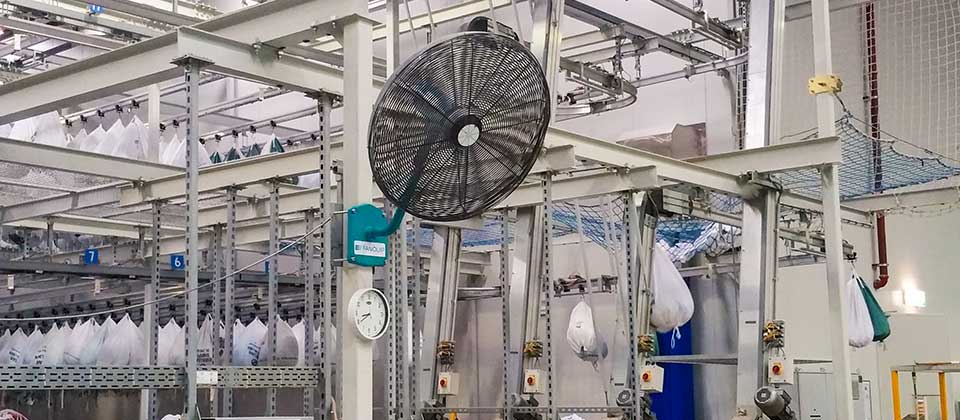
Air circulators supplement this in smaller or irregular spaces where a single HVLS unit doesn’t reach, or around specific problem surfaces that need more targeted air movement than a whole-space destratification fan provides.
- Giant fans (HVLS), for destratification that reduces the temperature gradient causing surface condensation
- Air circulators, for supplementary air movement in smaller zones or around specific problem surfaces
Winter fixes that still apply, and the one that doesn’t
General ventilation and airflow help with both problems, so if your facility already runs those controls well, keep them. What changes is the cause, and therefore the fix that actually solves it.
Winter condensation is a sealed-building moisture problem: process-generated humidity meeting cold surfaces, solved by managing moisture and ventilation. See condensation control in food processing facilities during winter for that side of it.
Spring condensation is a temperature-lag problem: surfaces that haven’t caught up with the air around them, solved by destratification instead.
A facility that reduces ventilation in cooler months to conserve heat can also run into a separate build-up of fumes and dust from that same sealing, covered in winter fume and dust hazards in industrial facilities. And running destratification fans as a year-round habit rather than a seasonal reaction has a cost case of its own, laid out in cost savings from destratification solutions.
Frequently Asked Questions
What causes condensation in spring that didn’t happen in winter?
Spring condensation is caused by a lag between air temperature and surface temperature. Cool overnight surfaces meet warmer, more humid daytime air before they’ve caught up. Winter condensation, by contrast, is caused by warm indoor moisture meeting a cold surface in a sealed building. The mechanisms are different even though the visible result, moisture on surfaces, looks similar.
Can the same fixes used for winter condensation help in spring?
Partially. General ventilation and moisture management help with both, but spring specifically benefits from destratification, which closes the temperature lag between air and surfaces, a mechanism winter fixes don’t directly target.
Which industries are most affected by spring condensation?
Food processing facilities with cold storage doors, warehouses, and manufacturing facilities with large roof areas and significant thermal mass are most exposed, essentially anywhere with a large surface area that cools significantly overnight.
Is this spring more likely to cause condensation issues than usual?
The Bureau of Meteorology’s spring 2026 outlook shows increased rainfall likelihood in parts of the country alongside above-average temperatures, both of which raise humidity and widen day and night temperature swings, conditions that increase condensation risk. This is a probability from BOM’s forecast, not a certainty.
Address the actual cause, not just the symptom
Browse Fanquip’s giant fans (HVLS) and air circulators range, or contact Fanquip for a condensation assessment specific to your facility’s surfaces and layout.