
Air curtains have a specific role in Australian food processing, cold storage, and industrial entry management that is shaped by Australian food safety legislation, DAFF biosecurity requirements, and the Australian climate. Fanquip has manufactured air curtains in Australia since 1984, supplying facilities across food processing, cold storage, retail, and manufacturing, and providing local technical support rather than relying on overseas distributors. This guide covers where air curtains are required or recommended in Australia, which industries use them and why, and how to select the right unit for an Australian facility.
For an explanation of how air curtains work, see how air curtains work.
Why Australian facilities specify air curtains
Under FSANZ Food Safety Standard 3.2.2, food businesses must take all practicable measures to prevent pests and contamination in food handling areas. Standard 3.2.3 (Food Premises and Equipment) reinforces this at the structural level, requiring walls and ceilings to be sealed against dirt, dust and pest entry, which is where a doorway control like an air curtain fits in practice. Air curtains are an accepted engineering control for preventing insect and pest entry at doorways that must remain open during food handling operations. They provide a functional barrier without requiring a physical door that staff must open and close during busy production periods.

Facilities handling agricultural produce, meat, and biological goods that are subject to DAFF biosecurity controls must prevent cross-contamination between zones of different biosecurity status. Air curtains at transitional doorways between high-care and standard care areas, or between quarantine and non-quarantine zones, support biosecurity separation without the workflow interruption of sealed doors.
Australian summer conditions, including high ambient temperatures, high humidity in tropical regions, and dust in arid areas, create specific challenges for entry point management. Air curtains prevent hot ambient air from entering refrigerated or climate-controlled spaces, reduce insect ingress, which peaks in warmer months, and limit dust entry in environments adjacent to unsealed roads or exposed yards.
Industries that use air curtains in Australia
Food processing and production
Air curtains are widely specified at entry points to food production areas, cold room doorways, and between production zones of different hygiene levels. The FSANZ requirement to prevent pest and contamination entry makes air curtains a practical compliance solution for facilities with high traffic doorways that cannot be kept closed. In meat processing and ready-to-eat food production, air curtains at the boundary between clean and unclean zones support food safety programs.
See air curtain benefits in food processing and production for a fuller treatment, and see the results of a real installation improving cold storage efficiency with air curtains for practical context on outcomes.
Cold storage and distribution
Cold room doorways experience the most significant air mixing of any air curtain application. Warm, humid ambient air entering a refrigerated space immediately begins condensing on cold surfaces and consuming cooling energy. An air curtain at a cold room door reduces warm air infiltration, lowers condensation risk, and reduces the refrigeration system’s energy consumption. In Australian cold chain logistics, where docks operate in high ambient temperatures for most of the year, the energy savings are significant.
See ventilation and air control in cold storage for broader cold storage ventilation guidance.
Retail
Large-format retail stores and supermarkets use air curtains at main entries to prevent ambient air from the carpark from entering the climate-controlled retail space. In shopping centres, air curtains at service entries and loading bays control air exchange between back-of-house and retail areas. In food retail, air curtains at deli and fresh food sections support food safety and pest control in the same way as food processing applications.
See air control at retail entry points for further detail.
Manufacturing and wholesale depots
Manufacturing facilities with large roller doors that must remain open during production use air curtains to reduce heat ingress in summer, heat loss in winter, and insect and dust ingress year-round. Wholesale depots with vehicle access to temperature-sensitive storage areas benefit from air curtains that maintain internal conditions without requiring manual door operation each time a vehicle passes.
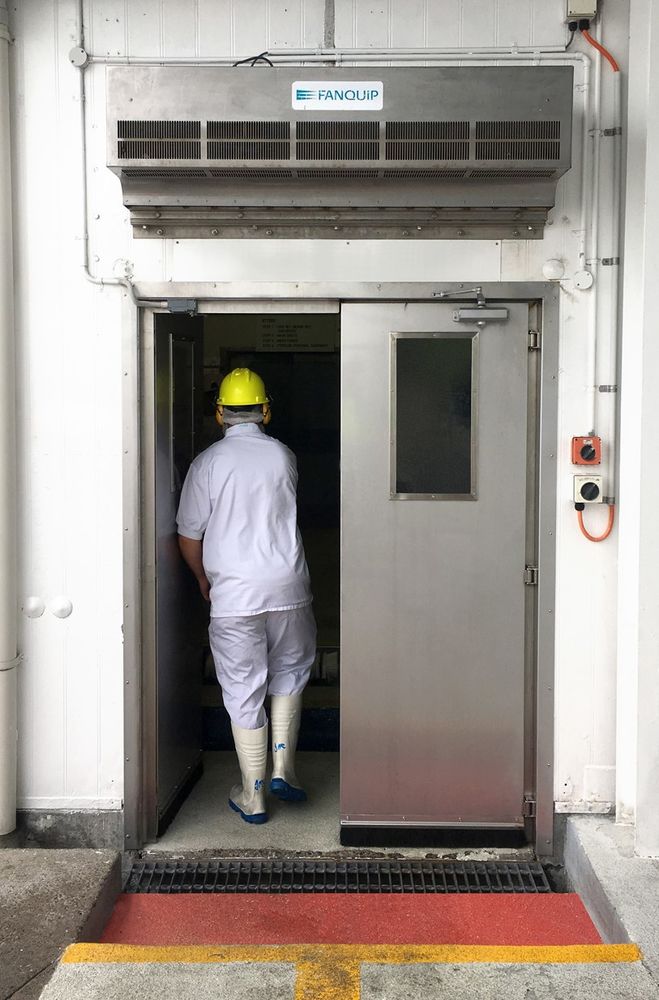
See entry point management in wholesale and depot environments for related guidance.
Agriculture
Poultry sheds, piggeries, and horticultural packing sheds use air curtains at entry points to prevent insect ingress, particularly critical in poultry operations where biosecurity requirements are strict, control odour migration, and separate zones of different biosecurity status. DAFF biosecurity requirements for facilities handling live animals or plant produce make air curtains a practical engineering control at transitional entry points.
Selecting the right air curtain for your Australian facility
Door width and height. Air curtain coverage must span the full width of the doorway. An undersized unit leaves gaps at the edges where air and pests can enter. Fanquip can supply units to match the doorway opening.
Air velocity. The air curtain must project at sufficient velocity to create an effective barrier at the base of the doorway. Higher ceilings and wider doors require higher velocity units. The correct velocity specification depends on the door height, the pressure differential between inside and outside, and the wind exposure of the doorway.
Temperature differential. At cold room entries where the differential between inside and outside temperatures can be 20°C or more, a higher-performance air curtain is required than at a standard ambient temperature entry. The high differential creates a stronger driving force for air mixing that the curtain must overcome.
Mounting requirements. Air curtains are typically mounted above the doorway on the interior face. Recessed mounting is available for new-build installations where the unit must be concealed in the ceiling void. Surface mounting suits retrofits.
Australian climate considerations. In tropical and coastal regions, corrosion-resistant casing and motor protection are important for long service life. In dusty environments, motor enclosure rating affects the fan’s longevity. Fanquip’s team can confirm the correct specification for the operating environment.
For guidance on sizing decisions specifically ahead of the warmer months, see choosing the right air curtain size for your facility.
Air curtains versus physical doors
Physical doors, including strip curtains, rapid-roll doors, and hinged doors, provide a higher level of separation than an air curtain and are the correct choice where a complete barrier is required, such as hazardous area separation, cleanroom entry, or high-security storage. Air curtains are the correct choice where traffic volume through the doorway is high enough that constantly opening and closing a physical door creates a workflow problem or a safety risk from doors swinging into traffic.
Many Australian facilities use both: a physical rapid-roll door that is normally closed, with an air curtain mounted inside to provide a secondary barrier during the period the door is opening and closing. This combination is common in food processing loading docks and cold room entries with high vehicle traffic.
Australian-made air curtains from Fanquip
Fanquip has manufactured industrial ventilation and air management products in Australia since 1984. Air curtains supplied by Fanquip are designed for Australian conditions, including the high ambient temperatures, humidity ranges, and corrosive coastal environments that imported products are not always rated for, and are supported by local technical staff rather than overseas warranty and service processes.
For facilities in regional Australia, local manufacturing reduces lead times significantly compared with importing. Replacement parts and technical advice are available without international shipping or time zone complications.
Browse the air curtain category or the air curtains product page.
Contact Fanquip to discuss your doorway dimensions, temperature differential, and installation requirements. Our team will recommend the correct air curtain specification for your facility.
Frequently Asked Questions
Are air curtains required by Australian food safety regulations?
FSANZ Food Safety Standard 3.2.3 requires food businesses to take all practicable measures to prevent pest and contamination entry into food handling areas. Air curtains are an accepted engineering control for doorways that must remain open during food handling operations. Whether an air curtain specifically is required depends on the facility’s food safety program and the risk assessment for each entry point.
Do air curtains comply with DAFF biosecurity requirements?
Air curtains can form part of a biosecurity management plan by providing a functional barrier at transitional entry points between zones of different biosecurity status. DAFF biosecurity compliance for specific facility types depends on the applicable biosecurity instrument and the facility’s approved arrangement. Fanquip recommends confirming specific compliance requirements with your biosecurity advisor.
What size air curtain do I need for my doorway?
Air curtain sizing depends on the doorway width, height, air velocity requirement, and the temperature differential between inside and outside the space. Fanquip can provide a specification based on your doorway dimensions and application requirements.
Can air curtains reduce refrigeration energy costs in cold storage?
Yes. By reducing warm air infiltration at cold room doorways, air curtains reduce the refrigeration system’s energy consumption. The energy saving is proportional to the traffic through the door, and high-traffic cold room entries benefit most significantly.
Are Fanquip air curtains available for large industrial doorways?
Fanquip supplies air curtains for industrial doorway widths across commercial and industrial applications. Contact Fanquip with your doorway dimensions for a specification.
Next steps
Browse Fanquip’s air curtain range, or contact Fanquip for an air curtain recommendation tailored to your Australian facility, climate, and compliance requirements.