
Before any worker enters a tank, vessel, underground chamber, or enclosed plant area, the atmosphere inside must be confirmed safe. Not just assumed safe, but confirmed through measurement, after deliberate mechanical ventilation has displaced whatever was in there before.
In many cases, the space cannot be safely entered to ventilate it manually. That is the problem a purging fan is built to solve.
What Purging Actually Means
Purging is the process of removing a contaminated or oxygen-deficient atmosphere from a confined space by displacing it with fresh air, achieving atmospheric conditions safe enough for entry or work. It is distinct from ongoing ventilation, which maintains acceptable air quality once work is underway.
A related process, inerting, uses inert gas rather than air to displace oxygen in spaces where combustion risk must be eliminated before any other action is taken. Purging with air follows inerting in many oil and gas procedures once the space is confirmed free of flammable concentrations.
Purging is not a precaution. It is a strict legislative prerequisite. Australian Work Health and Safety legislation and Australian Standard AS 2865 (Confined Spaces) dictate that a confined space must be thoroughly evaluated and undergo atmospheric testing prior to any entry. Purging is the vital mechanical step that makes a safe atmospheric condition achievable in environments where natural air exchange is compromised or entirely non-existent.
How a Purging Fan Works
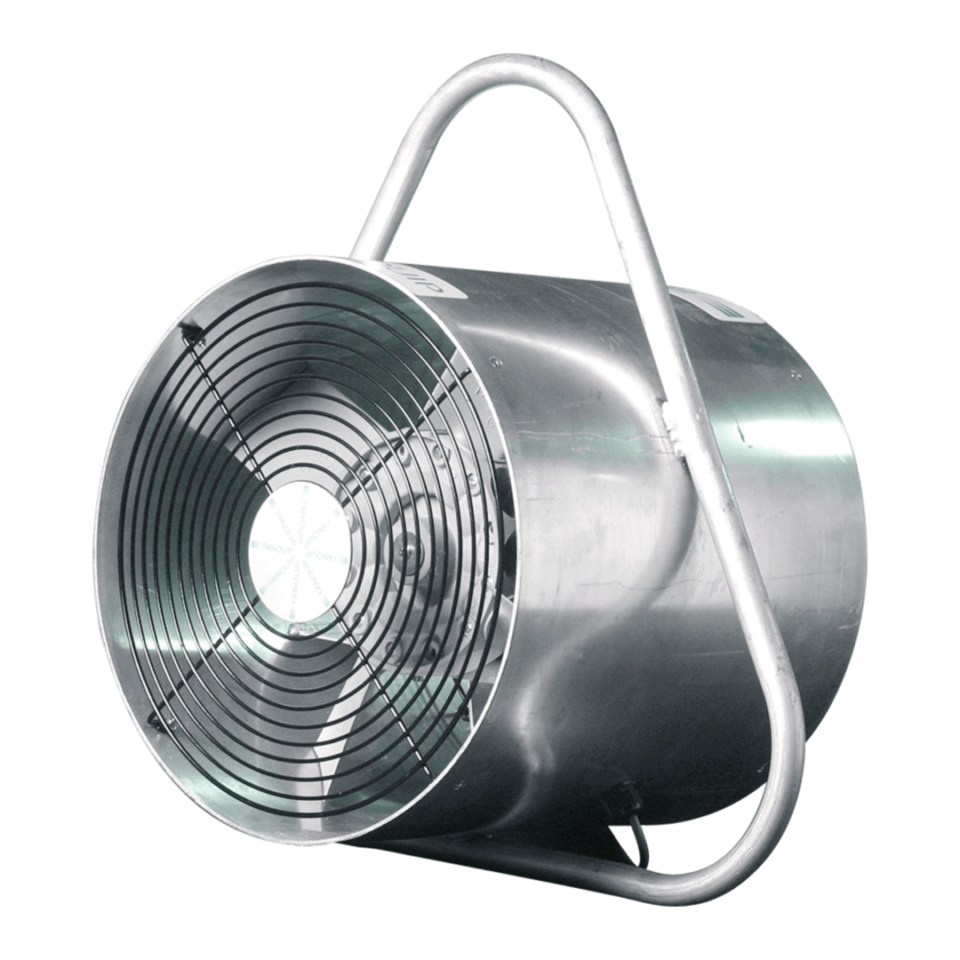
A purging fan is a specialised ventilation device designed to move a full air change through an enclosed space from outside it, without requiring anyone to be inside during the purge cycle. That remote operation capability is what separates it from a standard extraction fan placed at a hatch or opening.
Purging fans operate in two modes:
Positive pressure (supply) mode: The fan forces fresh air into the confined space through a duct, pressurising the interior and pushing contaminated air out through a separate exhaust point. This mode is preferred when the contaminant is heavier than air and sits at low levels, physically lifting and displacing the hazardous atmosphere from the bottom up.
Negative pressure (exhaust) mode: The fan draws air out of the confined space through a duct, creating a partial vacuum that pulls fresh air in through a separate inlet. This mode suits spaces where the contaminant rises or where controlling the exhaust point gives better directional control over the purge path.
The ducting is the critical element in both cases. A standard axial fan placed at a doorway or hatch moves air near the opening but leaves dead zones deeper in the space. A purging fan paired with rigid or flexible ducting delivers the airflow to the exact point where the contaminant is concentrated, ensuring a complete air change rather than surface-level movement.
Purging Fans vs. Standard Extraction Fans
This is the most important distinction to understand when specifying equipment for confined space work.
A standard axial flow fan is well suited to general ventilation in open or semi-open spaces: moving large volumes of air across a factory floor, clearing heat from a plant room with multiple openings, or providing background air movement in occupied spaces. They are not designed to deliver targeted airflow through a duct into an inaccessible space, and they are not rated for the atmospheric conditions typically found in confined spaces before purging.
For a detailed breakdown of how axial and centrifugal fans compare across applications, see axial flow fan vs centrifugal fan.
Centrifugal fans generate higher static pressure than axial fans, which makes them better suited to pushing or pulling air through long or narrow duct runs. In confined spaces with complex geometry or significant duct lengths, centrifugal fans can maintain airflow where an axial fan would stall against duct resistance. However, they still require purpose-built purging fan configurations to be deployed safely for confined space entry applications.
Purging fans are purpose-built for this specific task. Key differences include:

- Remote operation: Designed to run from outside the confined space with ducting extended into the hazardous zone
- Motor and housing ratings: Built for atmospheres that may contain flammable vapours, dusts, or corrosive gases at the start of the purge cycle
- Ducting compatibility: Engineered to work with flexible and rigid duct systems that direct airflow to the contamination source
- Positive and negative pressure capability: Configurable for the purge mode that suits the specific space geometry and contaminant type
Where Purging Fans Are Required
Oil and Gas
Tank farms, process vessels, pipelines, and enclosed plant areas in oil and gas facilities accumulate hydrocarbon vapours, hydrogen sulphide, and other hazardous gases in their lower zones. Before any maintenance, inspection, or entry, these spaces must be purged to confirmed safe levels. Purging fans are standard equipment for pre-entry procedures across the oil and gas sector, operating from outside the vessel through purpose-fitted access points.
Mining and Metals
Underground drives, ore passes, sumps, and equipment bays accumulate diesel exhaust fumes, methane, CO, and dust in configurations where natural ventilation cannot clear the space before worker entry. Purging fans attached to flexible ductwork can reach deep into underground workings, delivering fresh air to the face of the purge zone and extracting the contaminated atmosphere through a separate duct path.
Building and Construction
Tunnelling works, basement excavations, enclosed scaffold structures, and below-grade service pits all require purge ventilation before and during work. Carbon monoxide from plant and equipment, solvent vapours from adhesives and coatings, and oxygen depletion from chemical reactions in confined pours create hazardous atmospheres that cannot be assumed safe.
For a broader look at the ventilation and safety challenges specific to tunnelling, see risk factors for tunnelling in construction.
Purging fans provide the controlled air change required before entry and the continuous mechanical ventilation required while work proceeds.
Smelters and Refineries
Vessel and duct purging before maintenance shutdowns is a routine procedure in smelting and refining operations. Reaction vessels, electrolytic cells, and duct systems retain process gases and chemical vapours that must be fully displaced before any hot work, inspection, or maintenance access. Purging fans with extended duct runs handle the geometry of these large industrial vessels.
Food Processing
Fermentation vessels in brewing, winemaking, and food production generate CO₂ as a byproduct of fermentation. Because CO₂ is heavier than air, it accumulates at the base of tanks and enclosed vessel spaces. Workers entering to clean, inspect, or maintain these vessels have died from oxygen displacement without any visible warning. Purging fans in positive pressure mode, delivering fresh air to the base of the vessel through a duct, displace CO₂ upward and out before any entry is permitted.
For a closer look at how this applies specifically to winemaking operations, see winemaking vat purging fan. Cold store entries with poor air exchange present a similar risk and the same solution.
Selecting the Right Purging Fan
Selecting a purging fan for a specific application requires answering four questions:
1. What is the contaminant and where does it concentrate?
Contaminants heavier than air (CO₂, hydrocarbon vapours, H₂S) pool at the lowest point of the space. Contaminants lighter than air (methane, hydrogen) accumulate at the highest point. The answer determines whether positive or negative pressure mode is more effective and where the duct inlet or outlet should be positioned.
2. What is the geometry of the space and the required duct run?
Long, narrow, or complex duct runs require higher static pressure. Where duct runs exceed the capability of a standard purging fan, a centrifugal fan configuration provides the additional pressure needed to maintain adequate airflow at the duct outlet.
3. What volume of air change is required and in what timeframe?
Calculate the total volume of the confined space and determine the number of complete air changes required to drop contaminants down to safe, legal parts-per-million (ppm) levels. Divide this target volume by your available purging time window to determine your required airflow rate, typically measured in cubic metres per hour (m³/h). This target flow capacity will directly dictate the size and motor rating of the fan selected.
4. What are the atmospheric hazard classifications of space?
Flammable atmospheres require fans with appropriate hazardous area ratings. Confirm motor and electrical ratings against the hazardous area classification of the space before specifying any fan for use in or adjacent to a potentially explosive atmosphere.
For applications where the confined space hazard has been cleared and ongoing general ventilation is needed during work, an axial flow fan at the access point is usually sufficient to maintain acceptable air quality through the work period.
A Note on Cold Conditions
Cold dense air changes the behaviour of heavier-than-air gases in confined spaces. In winter, low-lying spaces such as sumps, pits, and below-grade vaults accumulate gas at higher concentrations because cold air is denser and less likely to convect upward naturally. CO₂, hydrocarbon vapours, and H₂S settle more persistently in cold conditions, making purge ventilation more critical, not less, during colder months. A space that clears quickly in summer may hold contamination significantly longer in winter under the same purge conditions. Account for seasonal temperature differences when estimating purge cycle duration.
Frequently Asked Questions
Can I use a standard pedestal or wall-mounted fan to purge a confined space?
No. A standard fan placed at an opening moves air near the entry point but cannot deliver a controlled air change to the deeper zones where contamination accumulates. It also lacks the ducting compatibility and, in many cases, the motor ratings required for operation adjacent to potentially hazardous atmospheres. A purpose-built purging fan with appropriate ductwork is required for compliant confined space purging.
How long does a purge cycle take?
Purge cycle duration depends on the space volume, the target air changes required to achieve safe atmospheric levels, and the fan’s airflow output in m³/h. There is no fixed duration. Atmospheric testing must confirm safe levels after purging, regardless of elapsed time. Never substitute a timed purge for measured atmospheric confirmation.
What is the difference between purging and ongoing ventilation in a confined space?
Purging clears the initial hazardous atmosphere before entry. Ongoing ventilation maintains acceptable air quality while work is being performed inside the space. Both are required. Purging fans handle the pre-entry phase; the ongoing ventilation phase may use the same fan at reduced output or a separate continuous ventilation setup depending on the work and space configuration.
Do purging fans have a role in welding and fume extraction applications?
Purging fans can be used to clear confined spaces before welding work begins, but fume extraction during welding is a different application handled by dedicated fume extractors. For welding fume control obligations and the control measures that apply during welding, see our articles on welding fume compliance for detail on those specific requirements.
Next Steps
Fanquip’s purging fan range is designed for industrial confined space applications across oil and gas, mining, construction, smelting, and food processing.
Contact our team to discuss your specific confined space geometry, hazard classification, and airflow requirements to ensure the right unit and configuration for safe pre-entry purging.