
Condensation on a production line ceiling is not just a maintenance issue. It is a contamination risk, a major food safety compliance concern, and a potential shutdown trigger. Water dripping from overhead surfaces onto food-contact equipment creates the exact conditions under which Listeria monocytogenes and Salmonella thrive.
In winter, when the temperature differential between warm, moisture-heavy production areas and cold external surfaces reaches its annual peak, the condensation risk in food processing facilities is at its most acute and its most manageable with the right combination of ventilation controls.
Why Winter Amplifies Condensation Risk in Food Processing
General warehouses get colder in winter. Food processing facilities get more dangerous. The distinction matters because the condensation mechanism in a food processing facility is not just about temperature differential. It is about the simultaneous presence of three conditions that do not occur in most other industrial environments:

Process-generated moisture is constant and high. Cooking, washing, blanching, and CIP cleaning cycles continuously introduce steam and water vapour into the production atmosphere. Unlike a warehouse where moisture is primarily ambient, a food processing facility generates its own humidity through production activity regardless of what the weather is doing outside.
Cold surfaces are everywhere and close to production. Cold room walls, refrigerated conveyor sections, and building fabric chilled by winter outdoor temperatures all present surfaces that sit at or below the dew point of the warm production-floor air. When warm moist air contacts those surfaces, condensation forms immediately.
The temperature differential peaks in winter. During summer, outdoor temperatures reduce the gap between inside and outside surface temperatures. In winter, that gap widens. A production floor operating at 18°C with 80% relative humidity has a dew point of approximately 14.5°C. A cold room door at 4°C, an external wall at 8°C, or a refrigerated pipe at 2°C all sit well below that dew point. Every one of those surfaces is an active condensation site during winter production.
Where Condensation Forms and Why It Matters
Production Ceiling and Overhead Structures
Warm moist air rises and contacts the coldest surface in the facility: the roof and ceiling structure. In winter, ceiling surface temperatures in uninsulated or lightly insulated sections drop significantly below the dew point of the production atmosphere. Water accumulates on the ceiling, on service pipes, on structural steelwork, and on overhead conveyor systems, then drips directly onto production lines and food-contact surfaces below.
This is not an acceptable maintenance condition. Under HACCP protocols and Food Standards Australia New Zealand (FSANZ) requirements, incidental condensation dripping onto food-contact surfaces constitutes a critical loss of environmental control. It triggers severe audit findings, immediate corrective action requirements, and in serious cases, total production suspensions. Even small amounts of condensation on non-contact surfaces create micro-environments optimised for pathogen growth and cross-contamination.
Do not use compressed air to blow condensation off overhead surfaces as a temporary fix. Compressed air aerosolises any pathogens present and distributes contamination across a wide area of the production zone.
Cold Room Doorways and Transitional Areas
Every time a cold room door opens, warm moist production-floor air floods the entry zone and meets the cold air and cold surfaces of the cool store. Condensation forms on the door frame, the floor, and the immediate wall surfaces. In high-traffic facilities, this cycling happens dozens of times per shift.
The condensation at cold room entries is a specific slip and contamination hazard that compounds over the course of a shift. Wet floors at cold room entries are among the most common incident sites in food processing facilities during winter. The moisture also carries whatever is on the production floor into the cold room entry zone, including organic matter that supports biofilm formation on doorframes and seals.
Loading Dock Transitions
Loading docks in food processing facilities create a direct interface between the warm production or cold storage interior and the cold winter exterior. In addition to the condensation risk on dock doors and bay approaches, repeated door cycling at the dock in winter introduces cold air spikes that drop ambient temperature in adjacent production zones, increasing condensation risk across a wider area.
For a full treatment of heat and condensation management at loading docks, see heating your loading dock in winter.
The Compliance Consequences
The NSW Food Authority, DAFF (for export facilities), and broader third-party food safety auditors treat condensation as an indicator of inadequate environmental design, not simply as a housekeeping issue. The consequences of uncontrolled condensation in a food processing facility include:
- HACCP non-conformances logged against environmental monitoring programs
- Corrective action requests that may halt production in the affected zone until the thermal or ventilation root cause is physically addressed
- Increased regulatory inspection frequency and auditing costs once condensation-related findings are recorded on a facility’s licence
- Product recall risk where condensation drip contamination is traced to a specific production batch
Failing to manage condensation in winter does not just affect compliance. It affects throughput and product quality. Excess moisture in processing areas slows production where products stick together, creating downstream problems in weighing and packaging. Moisture condensation on packaging equipment increases downtime. And for products with tight moisture specifications such as baked goods, confectionery, and dried produce, ambient condensation events can compromise product quality in ways that only become visible at end-of-shelf-life.
For a broader overview of general winter condensation strategies across facility types, see 3 ways to deal with winter condensation.
The Three-Product System for Winter Condensation Control
Condensation control in a food processing facility requires addressing the problem at three points in the mechanism: remove the moisture before it can condense, prevent warm and cold air from mixing at critical transition points, and raise surface temperatures in transitional zones above the dew point.
Roof Fans: Remove Warm Moist Air at the Source
The first line of defence is exhausting warm moist production-floor air before it rises to the ceiling and condenses on cold overhead surfaces. Fanquip’s roof fans draw the warm moist air column upward and out of the building continuously, reducing the moisture load in the production atmosphere and lowering the volume of humid air available to contact cold ceiling surfaces.

Roof fan placement matters in food processing: fans should be positioned above the highest-moisture zones, directly over cooking, washing, and CIP areas where steam generation is greatest. Running roof fans continuously during production shifts, rather than intermittently, maintains a consistent downward pressure on ceiling humidity levels throughout the production day.
Pair roof fans with axial flow fans at wall level to increase air movement across surfaces prone to condensation. Moving air dries surfaces faster than still air and reduces the dwell time for moisture that does form, limiting the window for pathogen colonisation on condensation-affected surfaces.
Air Curtains: Stop Warm and Cold Air Mixing at Transition Points
At cold room doorways and loading dock entries, the condensation mechanism cannot be addressed by extraction alone because the warm and cold air mixing happens at the moment of door opening, not during steady-state operation. Fanquip’s air curtains create a continuous high-velocity air barrier across the opening that prevents warm production-floor air from flooding into the cold room and cold air from spilling out onto the production floor.
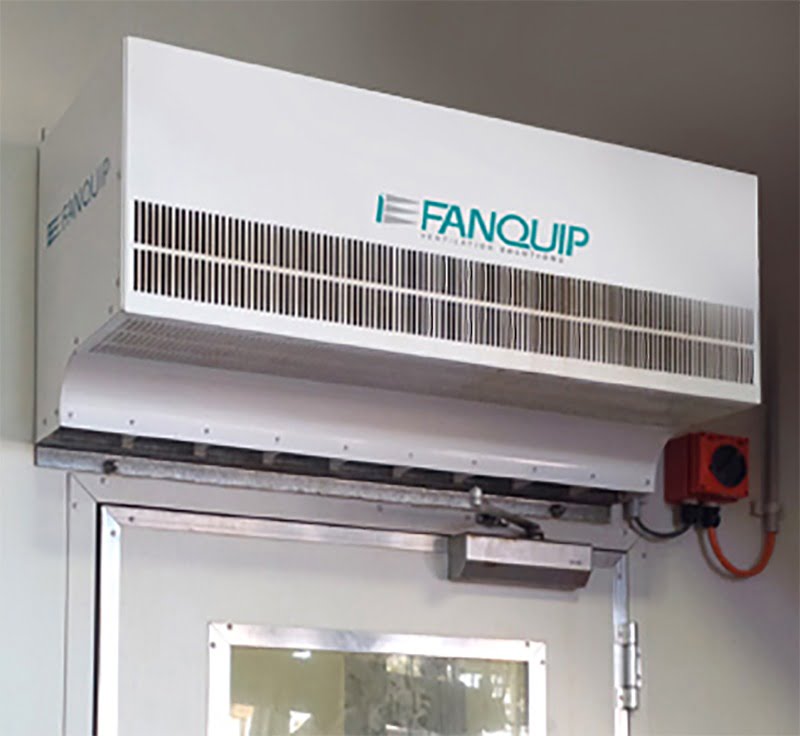
For food processing facilities, air curtains at cold room entries serve a dual function: they reduce condensation at the entry zone and they maintain cold room temperature integrity by limiting warm air infiltration. Both outcomes have direct food safety value. For a full breakdown of air curtain benefits in food production environments, see air curtain benefits.
Heater Fans: Raise Dew Point Risk Surfaces Above the Critical Threshold
In transitional zones where cold surfaces and warm moist air cannot be fully separated, raising the ambient temperature using Fanquip’s heater fans reduces the dew point risk by bringing surface temperatures above the dew point of the local atmosphere. A wall surface at 12°C in a zone with a dew point of 14.5°C will condense. Raise the ambient temperature of that zone to 16°C and the same surface rises above the dew point, eliminating condensation without changing the process or the cold room temperature.
Heater fans in loading dock staging areas, cold room anterooms, and production zones adjacent to refrigerated plant keep transitional surfaces above the critical threshold through the winter shift. Available in outputs from 7 kW to 36 kW, they can be sized to the thermal demand of each transitional zone rather than overheating the full production floor.
Filter Fans: Managing Air Quality in High-Moisture Environments
In high-moisture food processing environments, condensation and mould risk are closely linked. Surfaces that experience repeated condensation cycles accumulate organic matter and provide the moisture and nutrients that support mould growth. Fanquip’s filter fans maintain ambient air quality in high-moisture production zones by continuously filtering airborne particles, reducing the organic load available to settle on surfaces that experience intermittent condensation.
Cold Storage and Agriculture: Secondary Contexts
The condensation mechanism described in this article applies directly to cold storage warehouses at dock doors and transitional areas, and to cool rooms and produce stores in agriculture. In cold storage, the loading dock transition is the primary condensation and contamination risk site, as it is in food processing. On farms, cool rooms adjacent to processing or packing sheds face identical cold surfaces and warm moist air dynamics during winter production.
For cold storage specific ventilation guidance, see ventilation solutions for cold storage facilities.
Frequently Asked Questions
Is condensation on non-food-contact surfaces a compliance issue?
Yes. State food authorities, DAFF, and HACCP requirements extend well beyond direct food-contact surfaces to include walls, ceilings, and structural supports in production areas. Condensation on overhead structures creates conditions for biofilm formation and pathogen persistence that can transfer to the food-contact stream via drip, misting, or employee contact. Environmental monitoring programs in FSANZ-compliant processing facilities mandate non-food-contact surface swabbing specifically because of this transfer pathway.
Does dehumidification replace ventilation for condensation control?
No. Dehumidification removes moisture from the air but does not address cold surfaces or the temperature differential that causes condensation. Commercial desiccant dehumidifiers are effective at reducing relative humidity even at low ambient temperatures and can supplement ventilation-based controls in extreme cases. However, in a food processing facility with high continuous process moisture generation, ventilation-based controls that remove warm moist air before it can condense are generally more effective as the primary control than dehumidification alone.
How do I identify which surfaces are at condensation risk in my facility?
Install digital monitors that track temperature, relative humidity, and dew point in real-time in each production zone. When the dew point reading approaches the surface temperature of your coldest identified surfaces, you are within the condensation formation range. This allows you to adjust ventilation and heating controls before visible moisture forms rather than responding after condensation has already occurred on production surfaces.
Is Your Production Environment Condensation-Ready for Winter?
If your facility has cold room adjacency, high-moisture processes, or loading dock transitions and condensation is already a live issue this winter, acting now reduces the compliance exposure before it becomes an audit finding. Fanquip can assess ceiling zones, cold room entries, and transitional areas across your production environment and recommend a roof fan, air curtain, and heater fan configuration matched to your specific moisture sources and surface temperatures.
Contact Fanquip to arrange a condensation risk assessment for your food processing facility.