
Your extraction system has not changed. Your processes have not changed. But your workers are experiencing more headaches, more irritation, and air quality readings are creeping up. The difference is your building is sealed for winter.
The mechanism is specific: same hazard, same process, same equipment, but a fundamentally different seasonal baseline that makes existing controls inadequate.

Understanding why it happens is the first step to correcting it before the December 2026 exposure standard transition turns a seasonal management issue into a compliance failure.
Why Sealed Buildings Change the Fume Equation
In summer, industrial facilities breathe. Roller doors stay open, ridge vents draw naturally, and personnel doors cycle constantly. This background air movement dilutes contaminants continuously, even without deliberate extraction running. The air change rate a building achieves passively in summer can be two to four times higher than it achieves when sealed for winter.
When that passive dilution disappears, the extraction burden shifts entirely onto mechanical systems. If those systems were sized for summer conditions, which many are, they are now undersized for winter. The same welding process, the same grinding task, the same diesel equipment operating indoors, now generates fumes and dust into an environment that clears at a fraction of the summer rate.
The physics of contaminant accumulation in still air compounds the problem. Particles that would be carried toward an extraction point by background airflow instead settle into thermal layers, particularly in high-ceiling facilities where winter stratification traps warm contaminated air above the occupied zone. Gases that would disperse toward open doors instead accumulate at concentrations that build shift by shift.
The Processes That Become High Risk in Winter
Rather than providing a list of everyday workshop emissions, which is already covered extensively in our guide on managing fume and dust hazards, the critical focus here is identifying which specific processes tip from manageable to highly hazardous the moment a facility is sealed for the colder months.
Welding in enclosed workshops: Welding fume concentrations are directly tied to the air change rate in the work zone. A welder operating in a workshop with two open bays in summer may be operating under extraction that is adequate for those conditions. The same welder, same process, same extraction hood, in a sealed workshop in July is operating in a substantially higher ambient concentration. Under the tightened welding fume exposure standard that took effect in 2024, the margin for error is already narrow. The December 2026 WEL transition reduces it further. For a full breakdown of compliance obligations, see who is responsible for ensuring compliance with the welding fumes exposure standard.
Grinding and machining in sealed factories: Respirable dust from grinding, cutting, and machining stays airborne longer in still air. In summer, background airflow carries particles toward exhaust points passively. In a sealed winter factory, those particles follow gravity and thermal gradients rather than airflow paths, often settling into the breathing zone of workers at adjacent stations rather than reaching extraction points.
Diesel and LPG equipment operating indoors: Forklifts, generators, and mobile plants emit CO, NOx, and particulates at a constant rate regardless of season. In summer, open doors and natural ventilation provide significant dilution. In a sealed winter facility, these emissions accumulate. CO in particular reaches concerning concentrations in poorly ventilated winter facilities without any visible warning. This is one of the scenarios where sealed low-lying areas may also accumulate heavier-than-air gases, which is where purging fans become relevant alongside general dilution ventilation. For the full confined space application, see what is a purging fan and when do you need one.
Silica and process dust in enclosed construction and manufacturing: Cutting, drilling, and surface preparation in enclosed winter structures generate respirable crystalline silica dust that lingers significantly longer in still air than in ventilated summer conditions. The proposed reduction of the RCS limit to 0.025 mg/m³ under the December 2026 WEL transition means winter conditions in enclosed sites may push concentrations above compliance thresholds that were previously manageable.
December 2026 as the Compliance Pressure Point
The WEL transition on 1 December 2026 is not a distant administrative change. For facilities where winter conditions already push contaminant concentrations close to current WES thresholds, the new limits mean those same winter conditions will constitute a compliance failure from December 2026 onward.
The transition is particularly acute for:
- Welding operations, where the 2024 tightening already reduced the TWA from 5 mg/m³ to 1 mg/m³
- Silica-generating processes, where the proposed limit reduction is significant
- Any facility that has relied on background natural ventilation as part of its de facto control strategy without quantifying it
Facilities that have not conducted air monitoring under winter conditions specifically do not know their actual winter exposure profile. Monitoring conducted in summer or in a naturally ventilated facility does not represent the sealed winter baseline. For guidance on what control measures should be in place, see what control measures can be used to reduce welding fumes exposure.
Assessing Whether Your Current Extraction Is Adequate for Winter
The question is not whether your extraction system is compliant in general. The question is whether it is adequate when your building’s passive air change rate drops to near zero.
Run this assessment before the cold season:
- Identify your passive ventilation contribution. Walk each work zone and document which openings (doors, windows, vents, ridge ventilation) are open in summer and closed in winter. Estimate the air volume each contributes per hour. This is the dilution you are losing.
- Check whether your mechanical extraction rate covers the gap. If your extraction system was specified for a facility with a significant passive ventilation component, it is almost certainly undersized for sealed winter operation. Calculate the required air change rate for each work zone based on the process and the contaminant, then compare it to what your mechanical systems alone deliver.
- Conduct air monitoring under winter conditions. If you have air monitoring data, confirm it was collected under closed-building conditions. Summer monitoring data does not inform your winter compliance position.
- Identify accumulation zones. In facilities with high ceilings or complex geometry, fume and dust do not distribute evenly. Map where contaminated air is most likely to accumulate in still-air winter conditions and confirm extraction is positioned to capture from those zones.
Solutions Matched to the Winter Extraction Gap
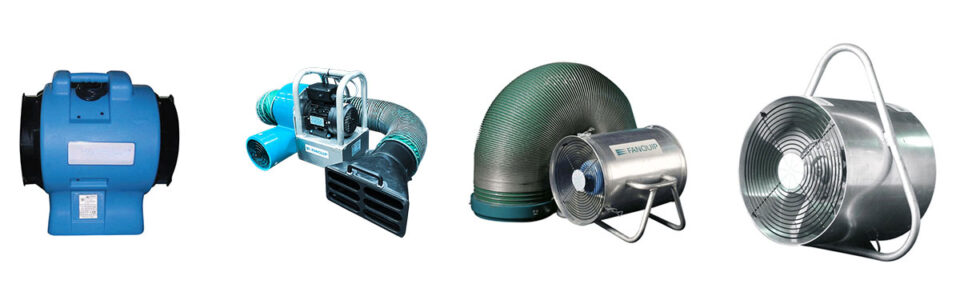
Balanced make-up air: High-powered extraction requires an equal volume of incoming air to operate at full design capacity. In a sealed winter building, running extraction without dedicated supply air can pull the facility into negative pressure, causing exhaust fans to stall against static pressure and risking the back-drafting of gas heater flues, which creates a direct CO hazard. Axial flow fans configured in supply mode deliver incoming air to offset extraction volume, maintaining pressure balance and ensuring extraction runs at rated performance without creating freezing drafts at uncontrolled entry points.
Point-source fume extraction: For welding, grinding, and machining, fume extractors positioned at the source are the primary control. In winter, this means not relying on any ambient dilution to make up the difference between the extractor’s capture rate and the full contaminant output of the process. The extractor must capture everything the process generates.

Ambient dust filtration: Where point-source extraction is not feasible for every dust-generating task, filter fans provide ambient filtration across the sealed facility. In manufacturing, construction workshops, and food processing environments, filter fans run continuously during occupied shifts to reduce the background ambient concentration that builds when passive dilution is absent.
Dilution ventilation with axial fans: Where extraction alone is insufficient, axial flow fans used for dilution ventilation push fresh air through the facility, reducing ambient concentration by increasing the mechanical air change rate. This is a supplementary measure, not a substitute for point-source extraction, but it addresses the passive ventilation gap that winter creates.
Frequently Asked Questions
If my extraction system passed an audit in summer, does that mean it is compliant in winter?
Not necessarily. An audit conducted under summer conditions, with doors open and natural ventilation contributing to air quality, does not represent your winter operating baseline. Compliance is determined by the conditions workers are actually exposed to during their shifts, not by the best-case scenario under which monitoring happened to be conducted.
How do I know if background airflow is contributing to my current fume control?
If your work zones have any openings that are closed in winter that were open during air monitoring or commissioning, background airflow is almost certainly contributing to your current performance. The simplest test is to close the facility to winter conditions and re-measure. If concentrations rise meaningfully, your mechanical extraction alone is not meeting the required standard.
Does the December 2026 WEL transition apply to all industries or only specific ones?
The WEL transition applies to all PCBUs across all industries where workers are exposed to airborne contaminants. It is not sector-specific. Every facility with fume or dust generating processes needs to confirm its controls will meet the new limits from 1 December 2026, under the conditions those processes are actually operated in, including winter.
Next Steps
If your facility has not been assessed under sealed winter conditions, contact Fanquip to discuss extraction adequacy across your work zones. With over 40 years of experience across manufacturing, mining, construction, smelting, and oil and gas environments, our team can review your current extraction setup and identify where the winter ventilation gap is creating a compliance risk before the December 2026 transition date. Browse our fume extractor range and filter fan range or contact us directly to arrange a site review.